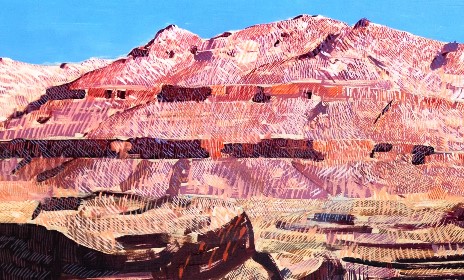
By the 1930s, Conrad Buff was considered one of the most important artists working in Southern California, forging a unique artistic vision during a transformative and often turbulent time in American art. Buff was a modernist—and was viewed as such—although his work never crossed over to more “radical” (Surrealist, non-objective) aspects of modernism, and he remained a painter of landscapes throughout his lifetime. His talents ranged across a number of different media, including easel and mural painting, lithography, and book illustration. His work was exhibited extensively in Los Angeles, but he was also nationally recognized during his lifetime.
Buff sought out the rugged, uncultivated, and unexplored areas of the American Southwest in Arizona, California and Utah that both delighted and challenged his audience. He often painted a large scale, which mirrored the vastness of the places he visited. Buff practiced a form of Divisionism, creating a unique technique using a cross-hatching style that informed his early work. By the 1950s, the tight, crossed-hatched application of paint that was a trademark of his early career morphed into the architectonic, reductive work that focused on primary colors. The subject matter remained the same, but his approach was entirely different.
Solitude and Silence is the first major museum exhibition to explore the artist’s career and life. The exhibition is accompanied by a fully illustrated catalogue and a comprehensive essay.
Solitude and Silence: Conrad Buff, Painter of the American Southwest